How to Store Cleaning Chemicals Safely With Kids Around
The cabinet under your kitchen sink is often the most dangerous spot in the house for a small child. Here's how child poisonings actually happen, and the simple order of changes that prevents them.
Picture the cabinet under your kitchen sink. For most homes, it holds the dish soap, the surface spray, the drain cleaner, the bleach, maybe a dishwasher pod bag. Now picture it at the height of a curious one-year-old. That cabinet is, for a small child, the most concentrated collection of poison in your home, stored behind a door with no lock, exactly at eye level.
Most child poisonings aren't dramatic. They happen quietly, in seconds, with ordinary household cleaners a parent used that morning and meant to put away properly. Understanding how they actually happen is the key to preventing them, so let me walk through it, because the fix is simpler than you'd think and it follows a clear order.
How a poisoning actually happens
It rarely looks like the warning labels imply. It's not a child prying open a childproof cap through determination. It's far more mundane, and that's what makes it common.
The scale of it is worth pausing on, because the numbers show this isn't a rare freak event. Household cleaning products are the second most common cause of unintentional poisoning in US children under six. Research published in Pediatrics by the Center for Injury Research and Policy at Nationwide Children's Hospital found more than 240,800 emergency department visits for cleaning-product injuries among children five and under between 2007 and 2022 — one injury every 35 minutes, for sixteen years. Bleach and detergents were the products most often involved, and detergent packets alone accounted for a third of cases. These are ordinary homes and ordinary products, not unusual circumstances.
The usual sequence: a bottle gets left out on the counter or floor "just for a minute" during cleaning. Or the under-sink cabinet, the one with no lock, gets opened by a child who has watched a parent open it a hundred times. A colourful bottle looks like a drink. A dishwasher pod looks exactly like candy or a squishy toy. The child tastes it. By the time anyone notices, it's already happened.The research bears this out. In the earlier study covering 1990 to 2006, children aged one to three accounted for 72% of cases, ingestion was the mechanism in roughly two-thirds, and spray bottles were the single most common container. That's the exact age of peak exploration, and the exact container most likely to be left out on a counter.
Two details from that sequence tell you where prevention actually lives. First, the danger concentrates in the moment a chemical is accessible, out on the floor, or behind an unlocked door. Second, the products most likely to be mistaken for food are the brightly coloured ones and the pods. Fix accessibility and you've fixed most of the risk.
The single most important change
If you do only one thing, do this: move cleaning chemicals up high, out of reach, before you think about locks.
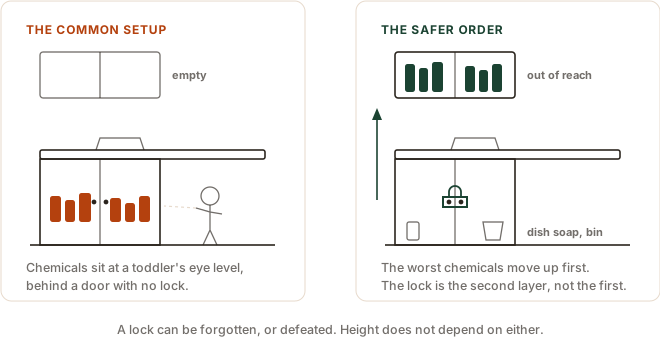
This is the order most advice gets backwards. People rush to buy cabinet locks for the under-sink cupboard and leave the chemicals right where they are, now behind a lock a determined toddler may eventually defeat, or that an adult forgets to re-latch. The stronger move is to relocate the actual hazard.
A high shelf or a wall-mounted cabinet a child can't reach removes the danger entirely, no lock required, no reliance on the latch working every single time. Height is the most reliable barrier there is, because it doesn't depend on a mechanism or a memory. Under-sink storage is convenient for adults, but convenience is exactly what makes it dangerous, it's low, and it's where little hands explore first.
A lock can fail or be forgotten. Height simply works, every time.
Safe Kids Worldwide notes that young children are often at eye level with what's under the kitchen and bathroom sinks, and advises moving cleaning products up and away, out of reach and out of sight. The federal Poison Help program's Up and Away campaign gives the same first instruction: pick a place too high for a child to reach or see. Height comes first in both.
Then lock what has to stay low
Some things genuinely have to live under the sink, the dish soap you use twenty times a day, the bin. For those, a lock is the right second layer, applied after you've moved the worst chemicals up.
The under-sink cabinet is usually a double-door cupboard with two handles, which is worth knowing because it determines what kind of lock fits. This is precisely the situation covered in the best under-sink cabinet locks, where a U-shaped slide lock through the two handles is often the right tool. The point is sequence: relocate first, lock second. A lock on a cabinet full of the worst chemicals is a weaker setup than an empty-of-poison cabinet with a lock on what remains.
And if there's a stove nearby, remember the under-sink cabinet is only one kitchen hazard among several. The full room-by-room childproofing audit covers how the sink cabinet fits alongside the stove, drawers, and tip-over risks.
Where each product belongs
| Product | Where it goes | Why |
|---|---|---|
| Drain cleaner | Up high, out of reach | Caustic — can burn on contact |
| Oven cleaner | Up high, out of reach | Caustic — can burn on contact |
| Bleach | Up high, out of reach | Most commonly involved product in ED visits |
| Ammonia | Up high, separate from bleach | Mixing the two releases a toxic gas |
| Dishwasher & laundry packets | Up high, sealed | Look like candy; a third of injuries in the data |
| Brightly colored sprays | Up high, out of reach | Up high, out of reach |
| Dish soap | Low, behind a lock | Used constantly, lower concentration |
| Sponges, cloths, bin | Low, behind a lock | Low risk |
The rules that prevent the common mistakes
Beyond storage height, a few habits close the remaining gaps, because most poisonings trace back to one of these being skipped:
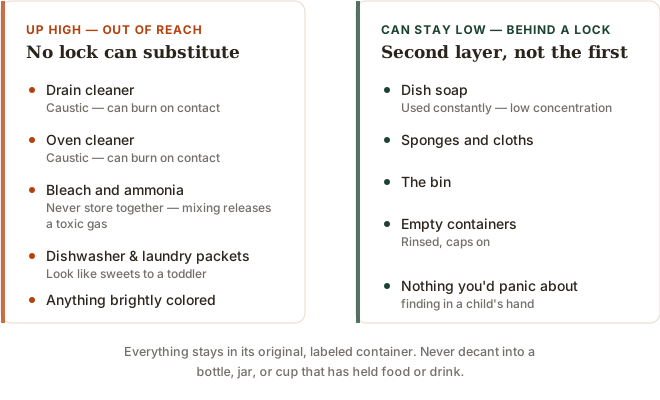
Never decant chemicals into food or drink containers. Pouring bleach into an old water bottle, or degreaser into a jar, is one of the most dangerous things you can do. A child, or an adult, trusts the container. Keep everything in its original, labelled bottle.
Put it away immediately, not "after I finish." The bottle on the floor during cleaning is the classic exposure moment. Close the cap and return it up high the instant you're done with it, not at the end of the whole job.
Treat dishwasher and laundry packets as high-risk. They're brightly colored, they look like candy or a squishy toy, and in the 2007–2022 data they accounted for roughly a third of all cleaning-product injuries in young children — with cases peaking after packets were introduced in 2012 and falling after 2015 once safety measures came in. Store them up high and sealed, never in a low drawer or an open bag.
Keep caps fully closed and know the number. Child-resistant caps only work when clicked shut. And keep the Poison Control number saved: in the US, 1-800-222-1222, free, 24/7. Program it into your phone now, not during an emergency.
Know which products are the worst offenders. Not every cleaner carries the same risk. The ones worth storing highest and most carefully are the concentrated and corrosive products: drain cleaners and oven cleaners (often caustic enough to burn on contact), bleach and ammonia (never stored together, since mixing them releases toxic gas), dishwasher detergent and pods, and anything in a brightly coloured bottle a child might mistake for a drink. If shelf space up high is limited, these are the ones that earn the top spots. The dish soap can live lower behind a lock; the drain cleaner should be somewhere a child cannot reach at all.
The bottom line
Storing chemicals safely with kids around isn't complicated, but the order matters. Move the worst chemicals up high first, because height is the barrier that never fails. Lock what genuinely must stay low, as a second layer. Never decant into food containers, put things away the instant you're done, and treat pods as the candy-lookalikes they are to a toddler.
Do the audit at your child's height, on your knees, looking at the room the way they see it. The under-sink cabinet that looks like storage to you looks like a treasure chest to them. Move the poison up, and you've solved the biggest hazard before a lock ever enters the picture.
Frequently asked questions
Where should I store cleaning chemicals if I have young children?
Up high, out of reach, is the safest place, ideally a wall-mounted cabinet or high shelf a child can't access. Height is the most reliable barrier because it doesn't depend on a lock working or an adult remembering to re-latch. Only after relocating the worst chemicals should you rely on cabinet locks for what has to stay low., Where should I store cleaning chemicals if I have young children?
Is it enough to just lock the under-sink cabinet?
It helps, but it's the weaker approach on its own. A determined toddler can eventually defeat some locks, and adults forget to re-latch. The stronger strategy is to move the most dangerous chemicals up high first, then lock what remains. Relocate, then lock, in that order.
Are dishwasher pods really dangerous for children?
Yes. They're a leading cause of young-child poisoning exposures because they look like candy or a squishy toy and are brightly coloured. Store them up high, sealed in their original container, never in a low drawer or an open bag within a child's reach.
What should I do if my child swallows a cleaning product?
Call Poison Control immediately. The number is 1-800-222-1222, free and available 24/7. Program it into your phone now so it's ready. If the child is unconscious, having trouble breathing, or having a seizure, call 911. Keep the product container handy so you can tell them exactly what was swallowed.
Sources & Standards
- Center for Injury Research and Policy, Nationwide Children's Hospital — Study Finds Household Cleaning Products Remain a Leading Source of Child Injury
- American Academy of Pediatrics — Household Cleaning Product-Related Injuries Treated in US Emergency Departments, 1990–2006
More on Kitchen Safety
Browse every guide and comparison we've published in Kitchen Safety.
Keep reading

Olive Tina
I lived through a kitchen grease fire in my own home. Afterward, I spent months researching what would have actually stopped it — that's how HouseholdShield started.