What Causes Scalding Burns, and the One Number That Decides Everything
Most people think a scald is about how hot the water is. It's really about how long skin touches it, and at your water heater's factory setting, “how long” can be as little as one second for a child. Here's the number that changes how you run your whole kitchen.
Ask most people what makes a scald dangerous and they'll say the same thing: how hot the liquid is. That's half the answer, and the missing half is the one that actually protects your family.
A scald isn't decided by temperature alone. It's decided by temperature and time — how hot, for how long. And once you understand the relationship between those two, something uncomfortable becomes clear: the hot water already coming out of most taps is set hot enough to send a child to hospital in about the time it takes to read this sentence.
Let me show you the number, then show you what to do about it.
The number: how long skin can touch hot water before it burns
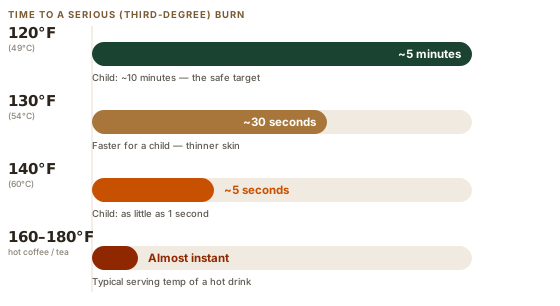
Here is the relationship every parent, and every person caring for an older relative, should know by heart. This is water temperature against the time it takes to cause a serious (full-thickness, third-degree) burn:
| Water temperature | Time to a serious burn (adult) |
|---|---|
| 120°F (49°C) | About 5 minutes |
| 130°F (54°C) | About 30 seconds |
| 140°F (60°C) | About 5 seconds |
| 160–180°F (hot coffee/tea) | Almost instant |
Read the jump between the rows. Dropping from 140°F to 120°F doesn't make the burn a little less bad — it changes the time from five seconds to five minutes. That twenty-degree difference is the difference between a burn that happens before anyone can react and one there's time to prevent.
And children don't get the adult numbers. A young child's skin is thinner, so it burns deeper and faster at every temperature. At 140°F, the water many homes actually run, a child can sustain a third-degree burn in as little as one second.
Hotter water doesn't burn worse. It burns faster. And “faster” is the whole danger.
Why this matters more than you'd think
Two facts reframe how seriously to take this.
First, scalds are not a rare freak accident — they're the most common burn injury among children under five, and children are eleven times more likely to be scalded by hot liquid than burned by fire or flame. We spend a lot of worry on flames and far too little on the mug and the tap.
Second, the danger is often built into the house. Many water heaters leave the factory set to 140°F — hot enough for that one-second child burn — because a higher setting was long treated as the default. Your tap may be delivering water at exactly the temperature these numbers warn about, right now, and you'd have no way of knowing without checking.
This is the part I find genuinely upsetting: it's not a hazard someone brings into the home. It's one that's already there, humming quietly in a cupboard, pre-set against you.
Where scalds actually happen (it isn't only the bathroom)
The bathroom gets the attention — and it deserves some, since a large share of young children's tap-water scalds happen there. But this is a kitchen safety site, and the kitchen has its own scald pattern that's arguably worse, because it involves liquids far hotter than any tap.
In the kitchen, the danger is hot liquid at a height a child can reach and pull down. A mug of coffee near the counter edge. A pot of pasta water. A bowl of soup at the table. Hot drinks are typically served at 160–180°F — hot enough to burn almost instantly — and the most common way a young child gets scalded is by pulling a hot drink or pot down onto themselves.
If you have young children, this connects directly to how you set up the room, which I've walked through zone by zone in how to childproof a kitchen, step by step. The short version: keep hot liquids pushed back, turn pot handles inward, and put your coffee down before you pick up your child.
The fixes, in order of how much they protect you
Here's the honest hierarchy — the things that matter most, first.
1. Turn your water heater down to 120°F. This is the single highest-value change, and it's free. Find the thermostat dial on the tank; if it shows numbers, set it to 120°F (49°C); if it shows words, "Warm" or "Medium" is roughly right. Wait 24 hours, then test a tap with a thermometer. One important caveat: don't go below 120°F, because water stored too cool can encourage Legionella bacteria. 120°F is the sweet spot — safe from scalds, safe from bugs.
2. Fit anti-scald devices where you can't control the temperature. If you rent, or share a water heater, or simply want a second layer, anti-scald devices exist for exactly this. Some are thermostatic mixing valves fitted at the heater; others are simple faucet or showerhead attachments that cut the flow to a trickle if the water suddenly runs dangerously hot. They matter most for homes with young children, older adults, or anyone who can't move away from hot water quickly.
3. Change three habits. Push hot drinks and pots to the back. Turn pan handles inward. And when running any water a child or older adult will touch, start cold, add hot, end cold, so a stray hot surge never lands on skin.
What to do in the first seconds of a scald
If it happens anyway, the response is the same one that's been proven for decades, and it's not butter, ice, or a home remedy:
- 1Cool the burn under cool (not ice-cold) running water for 20 minutes. This is the single most effective first aid, and the 20 minutes genuinely matters — it limits how deep the burn goes.
- 2Remove clothing or jewellery near the burn, but not anything stuck to the skin.
- 3Cover loosely with cling film or a clean, non-fluffy cloth.
- 4Don't apply ice, butter, toothpaste, or creams — they trap heat or cause further damage.
- 5Get medical help for any burn on a child that's larger than the child's hand, or any burn that blisters, chars, or looks white or leathery.
The one thing to do today
Everything in this article comes down to a single, free action you can take in the next ten minutes: go and check your water heater's setting. If it's above 120°F, turn it down, wait a day, and test it. That one adjustment quietly removes the most common serious burn risk in your home, the one that was built in before you ever moved in.
Nothing else on this page protects a child as much as that dial does. For the rest of the kitchen, see our complete kitchen safety guide.
Frequently asked questions
What temperature of water causes a burn?
Water at 120°F (49°C) takes about five minutes to cause a serious burn in an adult, and around ten minutes in a child, which is why it's the recommended safe setting. At 140°F (60°C) a serious burn happens in about five seconds for an adult, and in as little as one second for a young child. The hotter the water, the faster the burn — that speed is the real danger.
How hot should my water heater be set?
120°F (49°C). It's hot enough for washing and hot enough to discourage bacteria like Legionella, but cool enough that a scald takes minutes rather than seconds. Don't set it lower than 120°F, and after changing it, wait 24 hours and test a tap with a thermometer.
How long does it take to get burned by hot water?
It depends entirely on temperature. At 120°F, about five minutes. At 130°F, roughly 30 seconds. At 140°F, about five seconds for an adult, and around one second for a young child, whose skin is thinner. Hot drinks at 160–180°F burn almost instantly.
Why are children scalded more easily than adults?
A child's skin is thinner than an adult's, so it burns deeper and at a lower temperature — a child's skin burns in roughly a quarter of the time an adult's does. That's why the same tap water that's merely uncomfortable to you can cause a serious burn on a toddler.
Are anti-scald devices worth it if I can just turn down my water heater?
Turning the heater down is the best first step and it's free. Anti-scald devices matter when you can't control the heater — renters, shared buildings, or as a second layer in homes with young children or older adults — because they cap the temperature right at the tap even if the water surges hot.
Where do most kitchen scalds happen?
Not at the stove — from hot liquids pulled down from counters and tables. Hot drinks and pots of boiling water are the most common culprits, and the usual mechanism is a child reaching up and pulling the liquid onto themselves.
Sources & standards
- American Burn Association — Scald Injury Prevention Educator's Guide (temperature/time-to-burn data)
- Children's Hospital of Philadelphia — Burn prevention (pediatric scald timing)
- Parachute Canada — Hot tap water burns and scalds
- National Fire Protection Association — Scald burn safety
More on Kitchen Safety
Browse every guide and comparison we've published in Kitchen Safety.
Keep reading

Olive Tina
I lived through a kitchen grease fire in my own home. Afterward, I spent months researching what would have actually stopped it — that's how HouseholdShield started.