Are Stove Knob Covers Actually Worth It? What Testing Reveals
Stove knob covers are one of the most-bought baby-proofing products, and when a consumer lab actually tested them, most failed to stop a determined toddler. Here's why they fail, the two things that decide whether yours will work, and when a different tool is the smarter buy.
Here's an uncomfortable finding to open with: when a major consumer testing lab put stove knob covers to the test, most of them failed to stop a determined child from reaching the knob and turning it on. Out of the products they tried, only a couple actually did the one job you're buying them for.
That's not a reason to skip them. It's a reason to buy them, because the difference between a cover that protects your child and one that's decorative comes down to two things almost no listing tells you to check. Let me walk you through it, because this is one of those products where being informed is worth more than being cautious.
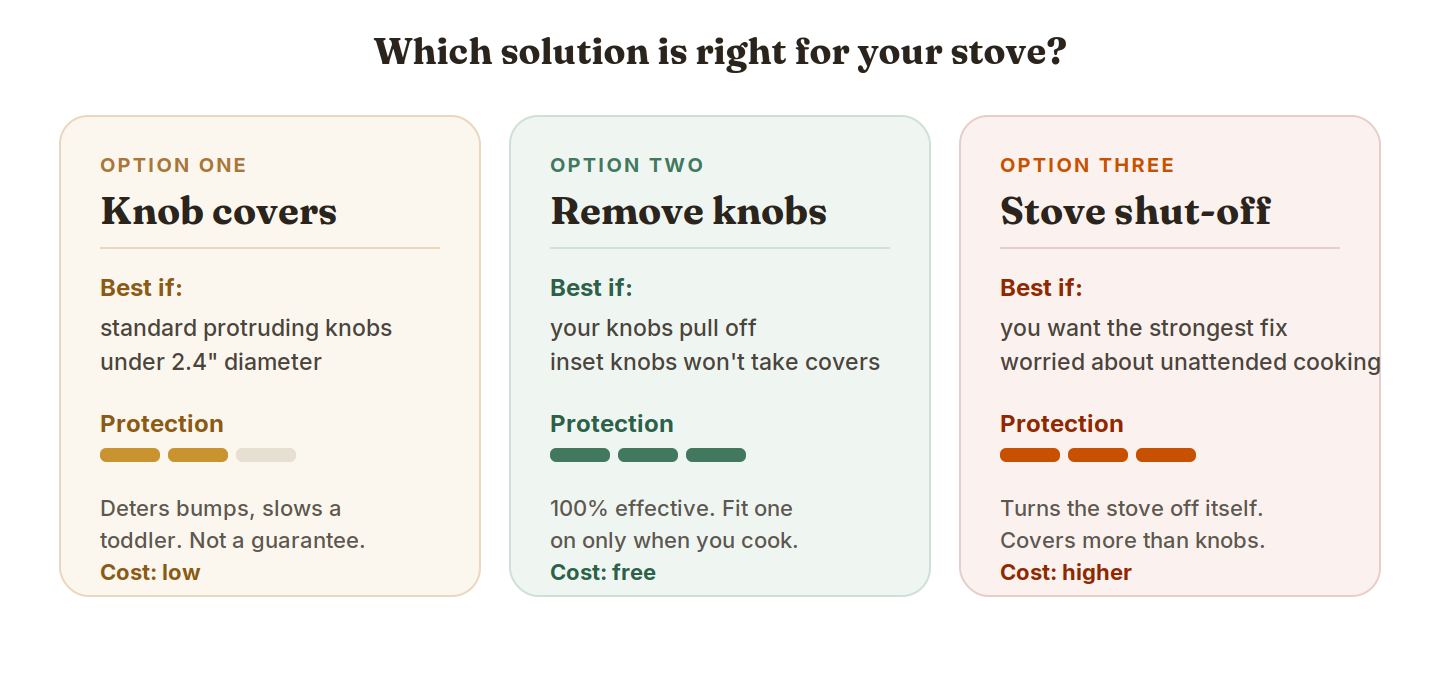
What knob covers are actually good at (and what they're not)
A stove knob cover is a clear plastic shell that snaps over the knob, so a hand has to open the shell before it can grip and turn. The honest version of what they do:
They are very good at stopping accidental activation: the hip that brushes a knob walking past, the pet that bumps the stove, the sleeve that catches. That alone is worth something; plenty of gas leaks and burner ignitions start with an inadvertent nudge.
They are less reliable at stopping a determined toddler, which is the thing you actually bought them for. A curious two-year-old has watched you open that cover a hundred times, has all day to try, and small hands are more capable than we give them credit for. The testing bore this out: a deterrent, yes; a guarantee, no.
A knob cover buys you a barrier and a few seconds of fumbling. It does not buy you the right to stop watching.
Hold onto that distinction, because it's what separates a smart purchase from a false sense of security. False security is genuinely dangerous, because it changes how carefully you supervise.
Why most of them fail: it's the fit, not the concept
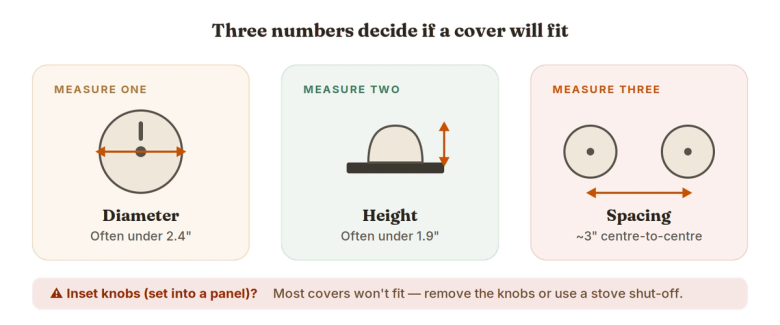
Here's the part that actually decides whether your knob cover works, and it's almost always buried at the bottom of the listing in tiny print: the cover has to physically fit your knobs, with enough room around them. Get this wrong and even a well-designed cover either won't go on, or goes on so loosely it pops off and a cover on the floor protects nobody.
| Measurement | Why it matters | Typical limit to check |
|---|---|---|
| Knob diameter | The cover has to fit over the whole knob | Often up to about 2.4" inner diameter |
| Knob height/depth | A deep or tall knob won't seat inside the shell | Often under ~1.9" |
| Space between knobs | Covers are bulky; crowded knobs collide | Often needs ~3" centre-to-centre |
Diagram showing the three measurements for stove knob covers: knob diameter, height, and spacing between knobs:
And one style of knob defeats most covers entirely: inset or recessed knobs, the kind set into a control panel rather than sticking out on the front. Many covers simply can't grip them. If that's your stove, a cover may be the wrong tool, and you should skip to the alternatives below rather than buy something that won't seat.
This is the whole reason the category has a bad reputation. It's not that the idea fails. It's that people buy a "universal" cover, discover it doesn't fit their particular stove, and conclude knob covers don't work. Measure first, and you've solved the most common failure before it happens.
Gas vs electric: the risk is different
Worth being precise here, because it changes how much a cover matters.
On a gas stove, a turned knob can do two dangerous things: light a burner, or release unlit gas if it's turned partway. That second one is the quiet danger (gas building up with no flame), which is why a gas hob is where knob covers earn their place most. If you cook with gas and have a toddler, this is a real priority, and it connects to why a nearby gas leak detector is worth considering too.
On an electric or induction stove, a turned knob heats an element, which is dangerous but at least visible and without the gas-leak risk. Induction is the gentlest case: many won't heat without a pan present at all. Covers still help, but the urgency is lower.
The honest alternatives (sometimes a better buy)
Knob covers aren't the only way to solve "my child can reach the knobs," and for some kitchens they're not the best way. Two alternatives worth knowing:
Remove the knobs entirely. On many stoves the knobs simply pull off. Keep them in a drawer and pop one on when you cook. It's free, it's 100% effective, and it defeats even the most determined toddler. The only trade-off is the minor daily faff. For a lot of families this quietly beats any product.
An automatic stove shut-off. A different category of device that turns the stove off after a period of inactivity or when it senses no one's there. It solves a broader problem than knob covers, including the unattended cooking that causes most kitchen fires, and I've compared the approaches in are automatic stove shut-offs worth it?. More expensive, but it protects against more than curious hands.
Best stove knob covers & oven-door locks
I looked at which knob covers actually fit which stoves — organised by knob type, so you buy one that works.
So are they worth it?
Yes, with three honest conditions:
- If they fit your stove. Measure diameter, depth, and spacing first. If your knobs are inset, look at removing them or a shut-off instead.
- If you treat them as a deterrent, not a guarantee. They stop bumps reliably and slow a toddler down. They don't replace watching.
- If you have gas. This is where they matter most, because of the unlit-gas risk.
For most families with a standard gas or electric stove and a toddler, a well-fitted knob cover is a cheap, sensible layer. Just buy it with your eyes open: measure first, supervise always, and remember that the cheapest perfect solution might be the knobs already sitting on your stove, waiting to be pulled off.
Sources & further reading
- Consumer Reports — Best Babyproofing Stove Knob Covers and Locks
- U.S. Consumer Product Safety Commission — Recalls & Product Safety Warnings
More on Kitchen Safety
Browse every guide and comparison we've published in Kitchen Safety.
Keep reading
Frequently asked questions
Do stove knob covers actually work?
They work well as a deterrent against accidental bumps and to slow a curious child down but when tested, most did not reliably stop a determined toddler from eventually getting the knob turned. Treat them as one layer that buys you time and reduces accidents, not a guaranteed lock. And they only work if they physically fit your knobs.
How do I know if knob covers will fit my stove?
Measure three things before buying: knob diameter (often needs to be under ~2.4"), knob height or depth (often under ~1.9"), and the space between knobs (often ~3" centre-to-centre). If your knobs are inset into a control panel rather than sticking out, most covers won't fit — consider removing the knobs or a shut-off device instead.
Are knob covers necessary if I have an electric stove?
Less urgent than with gas, but still useful. An electric element that gets turned on is a burn and fire risk, though without the unlit-gas hazard a gas hob carries. On induction, the risk is lowest since many won't heat without a pan. Covers help on any type; they matter most on gas.
Is it better to just remove the stove knobs?
For many stoves, yes — it's free and completely effective. If your knobs pull off, keeping them in a drawer and fitting one only when you cook defeats even a determined toddler. The only downside is the small daily inconvenience. It's often the best-value solution of all.
Do knob covers stop a child turning on the gas?
They make it much harder and stop accidental bumps, but a determined child may still manage it over time — testing found most covers weren't a reliable barrier against a curious toddler. On gas, pair a cover with supervision, and consider removing the knobs or fitting a shut-off for a stronger solution.
What's the difference between a knob cover and a stove shut-off?
A knob cover blocks access to the knob. A stove shut-off is a device that turns the stove off automatically after inactivity or when no one's present — so it also protects against unattended cooking, the leading cause of kitchen fires. Shut-offs cost more but solve a bigger problem.

Olive Tina
I lived through a kitchen grease fire in my own home. Afterward, I spent months researching what would have actually stopped it — that's how HouseholdShield started.