Best Automatic Stovetop Fire Suppressors for Kitchens — The Quiet Guardian I Wish I Had
I lived through a kitchen grease fire. The one thing I wish had been over that stove is a device that puts the fire out for you, even while you sleep. Here's how they work and which one fits your kitchen.
I've already told you about the night I lived through a kitchen grease fire—a pot of oil on a flame I thought I'd turned off, my sister's baby asleep down the hall, and the moment I lifted a lid I should never have touched and watched a sheet of flame reach up toward my face. We were lucky. The ceiling wasn't.
I think about that night more than I'd like to admit. And the thing that haunts me most isn't the flames it's how quiet it all was before it wasn't. The oil didn't scream. The stove gave no warning. I was asleep, the fire was already growing, and there was nothing in that kitchen working to stop it. That's the whole cruelty of cooking fires; the most dangerous ones happen exactly when nobody is looking.
So when people ask me what one thing I wish I'd had over that stove, my answer never changes.
An automatic stovetop fire suppressor. A small, silent guardian mounted under the hood that doesn't need me awake, doesn't need me calm, and doesn't need me to remember a single thing. It watches the burner it's assigned to, and if a real fire climbs up to it, it smothers it whether I'm standing right there, in the next room, or fast asleep.
This is the guide I wish someone had handed me back then. Let me walk you through it the way I'd explain it to my own sister.
What an automatic stovetop fire suppressor actually is
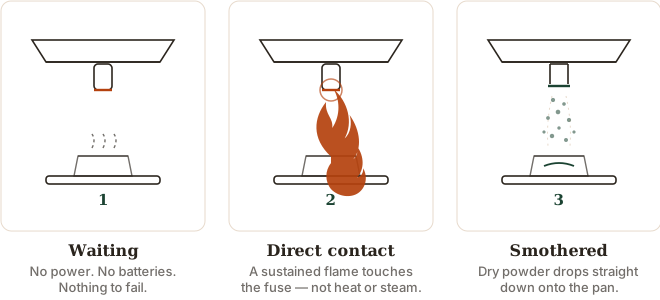
It's easier to picture than it sounds. Imagine a small metal canister about the size of a travel hairspray mounted under your range hood or over-the-range microwave, directly above a burner. Inside is a dry, non-toxic powder. Running along the bottom is a small fuse.
That's it. No wires. No batteries. No app. No electricity at all.
Here's the clever part: it reacts to only one thing direct, sustained flame touching the fuse. Not heat. Not steam. Not the smoke from searing a steak. An actual flame, reaching up from a real fire, holding against that fuse.
When that happens, the canister pops open and drops its powder straight down onto the fire, smothering it at the source. A standard four-burner stove is covered by one pair: one over the left burners, one over the right.
It is not a gadget. It's a last line of defense for the exact moment I lived through: when a fire has started and no one is there to react.
Who actually needs one (it's more of us than you'd think)
I used to believe fire suppressors were for restaurants and the very careful. I was wrong on both counts. The people who need this most are the people who think they don't:
- Anyone who has ever left a pan "just for a second." That second is the whole danger.Unattended cooking is the leading factor in home cooking fires and cooking fire deaths, according to the National Fire Protection Association. And the most dangerous ones happen when nobody is watching: fires reported between 11pm and 7am made up 17% of cooking fires but 19% of the deaths, with sleep a common factor, per NFPA's Home Cooking Fires report. Anyone in the house sometimes leaves the kitchen while something's cooking (all of us, if we're honest). If you're exhausted, stretched thin, or just forgetful. You come home drained, you put something on to cook, and you sink into the couch "just for a minute." Or you're someone whose mind genuinely wanders, and the burner slips from your thoughts. Best case, you wake to a ruined, smoke-filled dinner. The worst case is the one I don't have to spell out.
- Parents. A toddler tugs your attention away at the worst moment. The suppressor doesn't get distracted. Or a toddler tugs your attention away at the worst moment. I don't say this to scare you or to make you feel like a bad parent; you're doing the best you can with real constraints. I'm saying it because this is the moment a silent guardian over the stove earns its keep:
- Families with elderly parents, especially anyone who's gotten forgetful. A burner left on under an empty pot is one of the most common and most preventable disasters. You care for a child or an older parent whose memory isn't what it was, and the stove is a worry.
- Families with teenagers/ adolescents, If your kids or teenagers cook while you're at work. Many of us don't have a choice in this matter. The hours are long, the commute is brutal, and there are days you simply won't be home when your children get back from school, but they still need to eat, and you're not about to let them go hungry. So a teenager heats oil. A younger one "just makes noodles." And they're doing it with nobody experienced in the room, at the exact age where a phone buzzes, and attention drifts. It doesn't need your child to stay calm or know what to do. If a real fire starts, it acts on its own before your kid has to make a decision no child should have to make.
- Renters. You can't reinstall your landlord's smoke system, but you can mount one of these magnetically and take it with you when you leave. No drilling, no damage.
- Heavy sleepers, night-shift workers, anyone who cooks tired. That was me. That was the whole problem.
If you cook, you qualify. That's really the honest answer.
I was the person who panicked and did the wrong thing that night, and I was a grown adult. A suppressor won't fix the tiredness or the forgetfulness; nothing does, and I won't pretend otherwise, but it stands watch on the nights you can't. If forgetting the stove is a regular worry for you or an older parent, there's a whole other category of device automatic stove shut-offs.
And here's the part people skip past. These devices are inexpensive, with a small, one-time cost. A kitchen fire is not. When a grease fire escalates the way mine did, it doesn't politely stay on the stovetop. It takes the cabinets, the ceiling, the walls, and the smoke damage that soaks into everything you own. Some families are displaced for months. Prevention isn't just about safety; it's about not having to replace an entire kitchen and everything the smoke touched because, for ninety seconds, no one was in the room. That math has never been close for me.
My picks and exactly who each one is for
One brand keeps coming up as the proven standard because it's been doing this since 1972 and is the one fire departments and insurers actually recognize: StoveTop FireStop. The difference between their models isn't quality; it's what's above your stove. So pick by your kitchen, not by price.
| Model | What's above your stove | Clearance needed | How it mounts | Effective life |
|---|---|---|---|---|
| Rangehood | Traditional vent hood | ~27–35 in | Magnetic, under the hood | 6 years |
| Microhood | Over-the-range microwave or low cabinet | ~15–27 in | Wall-mounted beneath the microwave | 6 years |
| LowPro | Microwave or flat-bottom vent, tight space | Low clearance — confirm against spec | Low-profile under-mount | 6 years |
If you have a traditional vent hood over your stove, the StoveTop FireStop Rangehood is the original and the one I would start with for most homes. It hides almost completely from view and carries a six-year effective life with zero maintenance, no inspections, no upkeep, just an occasional wipe if grease builds up. One pair protects a four-burner stove. It works on gas, electric, induction, and glass-top ranges.
But I don't want to hand you a single gadget and call it safety. A grease fire gives you seconds, not minutes. So I think of kitchen fire protection as three layers, each covering the moment the others can't.
Layer one—the protection that works when you can't.
This is the piece I'd mount first. It needs no power and no attention: heat-and-flame activated, it drops its powder straight down onto a stovetop fire the moment flames reach it, whether you're asleep, on the phone, or out of the room. It's the original, in use since 1972, and independently tested and recommended by fire departments and insurers (some insurers even offer a small discount worth asking). There are two versions, and the right one depends on one thing: what's above your stove.
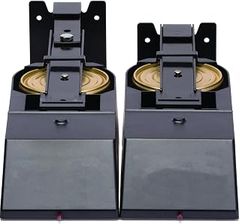
Microhood Fire Suppressor (1 Pair)
- Purpose-built for low clearance, where the standard model can't be fitted
- White and black finishes keep it visually quiet in a small kitchen
- Same six-year, zero-maintenance, no-power design as the Rangehood
- Wall mounting works where there's no hood surface to clip to
- Wall mounting is less forgiving than magnetic — placement has to be right first time
- Same six-year replacement cycle and same recurring cost
- Coverage is still limited to the burners directly below it
- Not third-party listed to UL 300A
If you have a traditional vent hood → the range hood. It clips magnetically under a standard range hood (roughly 27–35 inches above the cooktop), is hidden almost from view, and one pair covers a four-burner stove. For most kitchens, this is the answer.
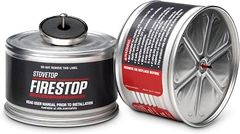
Fire Suppressor (1 Pair)
- Nothing to charge, wire, test or remember — it works in a blackout
- Magnetic mount means no drilling, so renters can install and take it with them
- Dry agent smothers burning oil instead of erupting it, the way water does
- Works across gas, electric, induction and glass-top ranges
- Six-year life means a recurring replacement cost, and an expired unit is just a metal can
- Only protects the burners directly beneath it — an oven or toaster fire is outside its coverage
- Requires a hood at the right height; wrong clearance and it's the wrong product entirely
- Not third-party listed to UL 300A, unlike some newer certified systems
If you have a microwave over your stove, the microhood. So many of us have that over-the-range microwave, which leaves too little room for the range hood. The Microhood is built for exactly that tight space (about 15–27 inches) and mounts beneath the microwave. Same silent protection, sized for the kitchen, the range hood doesn't suit it. Don't force the wrong one; measure your clearance first.
Layer two your fastest move when you're standing right there.
Here's what most people get wrong in the moment: water on a grease fire causes an eruption. I know, because I watched it happen. A fire blanket is the correct first response throw it over the flames, and it smothers the fire in seconds by cutting off oxygen. No chemicals, no mess. Keep it in a drawer within arm's reach of the stove, never directly above it.
Layer three for when it's grown past the pan.
A blanket handles a contained pan fire, but if flames reach the wall, the cabinets, or an outlet, you need more reach. A kitchen rated extinguisher handles grease, electrical, and ordinary fires the everyday tool every home should have, and almost none do. Mount it near an exit, not beside the stove, so you never reach through a fire to grab it.
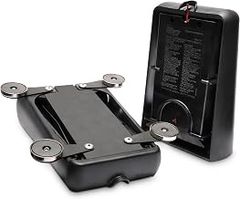
LowPro Fire Suppressor
- Nearly disappears under a microwave or flat vent
- Same protection and same six-year life as the other models
- Suits tight installations where a standard canister protrudes awkwardly
- Same six-year replacement cycle, same limited coverage area
- Availability is patchier than the other two models
- Confirm the clearance range against the spec before buying; it isn't interchangeable with the Microhood
If you want it nearly invisible, the StoveTop FireStop LowPro. A slimmer, low-profile version made to tuck under a microwave or flat-bottom vent and basically disappear. Same idea, more discreet. Worth knowing about if the look of your kitchen matters to you and clearance is tight.
Worth knowing — the certified, longer-life option. If you specifically want a device that's third-party listed to the residential cooktop standard (UL 300A) and lasts longer between replacements, there are newer systems — like FireBot — that use a non-toxic liquid agent, carry that certification, and advertise a longer service life. They cost more and are a different style of device, but if certification is a priority for you, they're a legitimate route. I'd rather tell you they exist than pretend the powder canisters are the only path.
How to choose in 60 seconds
Don't overthink this. Stand in front of your stove and answer;
Three questions. Your clearance decides the model, not your stove.
Q1 — What's directly above your cooktop?
- 1A traditional vent hood
- 2An over-the-range microwave
- 3A low cabinet or shelf
- 4Nothing — open ceiling or wall.
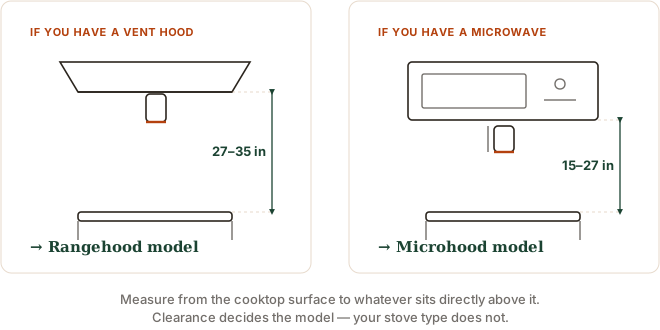
Q2 — Measure from the cooktop surface up to it. How far?
- 1Less than 15 in
- 215–27 in
- 327–35 in
- 4More than 35 in
- 5I haven't measured yet
Q3 — How many burners?
- 1Four or fewer
- 2Five or more, or a double range
You don't need to worry about your stove type, these are made to work on gas, electric, induction, and ceramic glass-top alike. (If you cook with gas, do read the manufacturer's note about gas ranges and follow the install instructions exactly.) And clearance is the one number that matters most, so grab a tape measure and check the distance from your cooktop to whatever's above it before you buy. That's it.
The honest "buy smart" part
I'd be failing you if I didn't say this plainly, because your safety matters more than a sale:
These have a six-year life; respect it. The powder and fuse are only guaranteed for that window. Buy fresh stock, check the date code on the canister, and put a reminder in your phone to replace them when they expire. A fire suppressor past its life is just a metal can. (Fire-safety products do occasionally get recalls too it's worth registering yours with the manufacturer so you'd actually hear about it.)
A suppressor is a safety net, not a license to walk away. It's the thing that saves you on the night everything else fails but it works with your smoke alarm, a kitchen-rated extinguisher within reach, and the oldest rule there is: don't leave cooking unattended. Layers. Always layers.
And here's the math that finally made it click for me. My sister's kitchen needed a new ceiling, repainting, and weeks of disruption with a baby in the house, and we got off easy. A pair of these costs about what a nice dinner out does. I have never once regretted spending a little to prevent a lot. Prevention is almost always cheaper than replacement t's just quieter about it, so we forget.
A small thing I want you to do today
If you take nothing else from this: go stand in front of your stove tonight, look up, and notice how nothing up there is working to protect you. Then fix it. It's a fifteen-minute job and a six-year peace of mind. I wish, more than almost anything, that someone had told me that before I learned it the way I did.
Sources & Standards
- National Fire Protection Association — Safety with cooking equipment
- National Fire Protection Association — : Home Cooking Fires report
- National Fire Protection Association — Home Cooking Fires (Hall & McGree, September 2023)
- U.S. Fire Administration (FEMA) — Cooking Fire Safety
More on Kitchen Safety
Browse every guide and comparison we've published in Kitchen Safety.
Keep reading
Frequently asked questions
Do automatic stovetop fire suppressors really work?
Yes. This type has suppressed residential grease fires since 1972, and the flame-activated design is recommended by fire departments and insurers and used in homes and rentals across the country.
Will it go off by accident while I'm cooking?
No. It only triggers when a flame makes direct sustained contact with the fuse. Everyday cooking heat, steam, and smoke won't set it off.
Can I use it on gas, electric, induction, or glass stoves?
It's been successfully tested on electric and gas and works on induction and ceramic/glass tops too, as long as it's installed according to the instructions. If you cook with gas, read the maker's gas-stove notes first.
How long does it last?
A six-year effective life, then replace it—no batteries, no recharging.
Does it need maintenance?
None. Wipe off grease gently with a damp cloth, keeping liquid away from the fuse and label.
Will it make a mess like a sprinkler?
No water, no flooding — it releases a dry powder onto the grease fire, so cleanup costs far less than water damage.
Can it lower my insurance?
Sometimes some insurers offer a small discount, but it varies, so ask your provider directly.

Olive Tina
I lived through a kitchen grease fire in my own home. Afterward, I spent months researching what would have actually stopped it — that's how HouseholdShield started.