How to Prevent a Kitchen Grease Fire — From Someone Who Lived Through One
A pot of hot oil on a "low" flame nearly burned down my sister's house with a baby inside. Here's everything I learned about preventing a kitchen grease fire — so it never happens to you.
I need to tell you about a morning that still makes my chest tighten when I remember it. I'm telling you because I would give anything to keep you from ever feeling what I felt that day, and because nearly everything that went wrong was preventable.
This was years ago, before I was married, before I had my own child. I was staying with my sister and looking after her baby. I'd just finished frying, and when I went to turn off the gas, I honestly believed I had shut it all the way off. I hadn't. I'd turned it down to the very lowest flame, and the pot of oil still sitting on it was already hot from cooking.
Then I did the most ordinary, human thing in the world. I was tired, and I fell asleep.
What woke me wasn't an alarm. It was a smell, that thick, sharp stench of burning oil. I stumbled into the kitchen half-awake and confused, trying to figure out where it was coming from. And then I made the mistake that nearly cost me my face: I lifted the lid off the pot to look inside.
- That rush of fresh air was all the fire needed. It roared straight up at me. If my body hadn't yanked my head back on pure instinct, that reflex that fires before your brain can even catch up, I don't let myself imagine how that ends.
My very next thought was the baby. Then the house. Then a flood of "what ifs":
What if it burns down
What if we're left with nothing,
What if it reaches the gas line?
In my panic, I grabbed water and threw it on the flames. I will never forget what happened next. The water hit the hot oil, and the whole thing erupted. Grease, steam, and balls of fire thrown across the room. The flames didn't die. They climbed, reaching for the ceiling. I ran outside screaming for help, and no one came; it was morning, and the neighbors had already left for work. I stood there shaking, certain the fire was about to follow the gas pipe and take the entire house with it.
Eventually, it burned itself down, but not before it destroyed a great deal and left me with a scorched ceiling I had to pay to repair. We were lucky. The baby was safe. I was alive. But "lucky" is not a fire-safety plan, and I never, ever want you to have to lean on luck the way I did.
So let me walk you through this gently the way I wish someone had walked me through it before that morning. Here's how to prevent a kitchen grease fire, exactly what I got dangerously wrong, and what to do instead if you ever find yourself facing one.
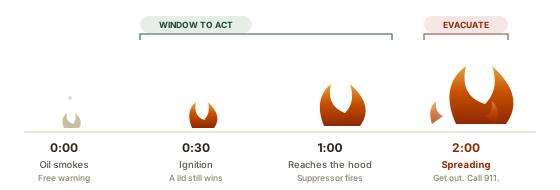
How do grease fires actually start?
A grease fire isn't a normal flame from a spark. It's cooking oil that gets so hot it bursts into flame on its own. As oil passes its smoke point, it begins to smoke, then ignites with no spark at all and research has found that hot oil left unattended can self-ignite in as little as 18 minutes. Cooking is the number one cause of home fires in the United States, according to the National Fire Protection Association, and oil and grease are behind most of them. The leading reason of all? Unattended cooking, which is exactly what caught me.
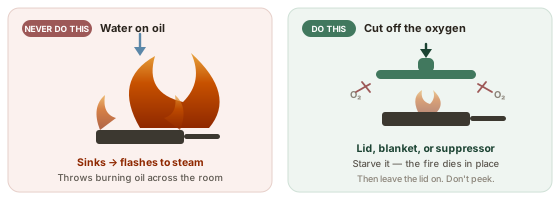
Two things turned my fire from frightening into life-threatening, and I need you to hold onto both: I opened the lid, which fed the fire a rush of oxygen, and I poured water on it, which turned it into an explosion. Remember those two. We'll come back to them.
How to prevent a kitchen grease fire: the habits I now live by
None of these is hard. Every one of them is something I'd trade that whole terrible morning to have done.
1. Never leave the stove, and always double-check the knob is fully OFF. My entire nightmare started with a knob I thought was off. Now I look; I check if the flame is truly gone, and if I have to step away even for a second, the burner goes off first. Unattended cooking is the single biggest cause of these fires.
2. Heat oil slowly, and stop the instant it smokes. If your oil starts to smoke or smells sharp, it is already too hot and seconds from danger. Turn the burner off and let it cool. That smoke is the warning I slept through.
3. Keep a metal lid right next to the pan. A lid is the fastest, safest way to smother a pan fire by starving it of oxygen—but only if it's already within reach. Whenever I fry now, the lid sits right beside the pan.
4. Dry food and lower it in gently. Water and hot oil don't mix. Pat food dry, never drop frozen food in, and add everything slowly and away from you so it can't splatter into the flame.
5. Match the oil to the heat. Every oil has a smoke point. High-heat cooking like deep-frying pushes oil close to its limit, so pick the right oil for the job and watch the temperature—a simple thermometer takes the guessing out of it.
6. Keep the cooktop clean and clear. Built-up grease is fuel. Wipe down after cooking, and keep paper towels, dish cloths, packaging, and curtains away from the burners. Turn pot handles inward, and wear short or close-fitting sleeves.
7. Keep little ones a safe distance away. A no-go zone of a few feet around the stove prevents bumps, spills, and the kind of split-second distraction that leads to an unattended pan.
8. Keep working smoke alarms overhead. The morning of my fire, there was no alarm to wake me—a smell did. Don't gamble on that. Mount alarms about 10 feet from the cooktop to avoid false alarms, and test them every month. The NFPA reports that one in four home cooking-fire deaths happens while the victim is asleep. I was asleep. Please don't be unprotected the way I was.
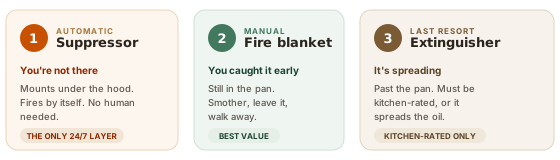
9. Keep the right backup within reach. Have a Class K or Class B fire extinguisher (the kind made for cooking oil) or a kitchen fire blanket nearby. There's also a newer safeguard I'll come back to: automatic stovetop fire suppressors that sit above the stove and put out a flame on their own.
If a grease fire ever starts — please, do what I didn't
If it happens, every second counts, and the instinct that feels right in panic is often the one that nearly killed me. So here is the calm version I wish I'd had in my head:
Do this:
- Turn off the heat if you can safely reach it.
- Cover the pan with a metal lid or a cookie sheet — and leave it on until everything is completely cool. Do not lift it to peek, the way I did.
- For a small fire, smother it with baking soda or salt.
- Use a Class K or Class B extinguisher only as a last resort.
- If it's growing or you can't control it, get everyone out, close the door behind you, and call 911.
Never pour water on a grease fire. I did, and it exploded — the water flashed to steam and threw burning grease across the room and up toward the ceiling. Never move the burning pan, never use a wet towel, and never throw flour, baking powder, or sugar on it. These don't put it out — they make it far worse.
If you want the full, calm, step-by-step version to keep on your fridge, read how to put out a grease fire safely.
Why prevention beats the cleanup every single time
Here's the part I learned the hard way. After the fire died, I was left with a blackened ceiling to repair and a long list of ruined things to replace and that was the good outcome. It cost me real money, real stress, and a fear that took a long time to fade.
Now compare that to what would have prevented it: checking a knob. Keeping a lid on the pan. A working smoke alarm. A small extinguisher or suppressor that costs a tiny fraction of one ceiling repair. Prevention is almost always the cheap option a few free habits and one or two inexpensive tools standing between you and a bill, or a loss, you can never fully undo. And some of what's at stake are the people in your home; the roof over their heads has no price tag at all.
The backup I wish I'd had that morning
If there's one gap I think about most, it's the unattended moment. The phone call, the crying baby, the nap you didn't mean to take. That's exactly the gap an automatic device is built for. I researched and compared the leading automatic stovetop fire suppressors how they mount above the stove, how they trigger on their own when a flame reaches them, and which kitchens they suit best. They're not a replacement for good habits. They're a safety net for the very human moments when your attention slips the moments that nearly cost me everything.
You can keep your kitchen safe
I told you my worst morning so that yours never comes. The truth is, a grease fire feels like terrible luck, but it's almost always preventable: stay with your pan, check that knob, heat oil slowly, keep a lid close, hold flammables back, and keep a working alarm overhead. Do those, add a simple backup, and you've removed the conditions a grease fire needs to exist. That's real peace of mind and you deserve it.
For everything else that protects your cooking space, from gas leaks to anti-scald safety, see our complete kitchen safety guide.
Sources
- National Fire Protection Association (NFPA) — Home Cooking Fires report and cooking safety guidance
- U.S. Fire Administration / FEMA — residential cooking fire statistics
- Journal of Fire Sciences (2018) — cooking oil autoignition study
- State and municipal fire departments — grease fire response and prevention guidance
This article is my personal experience and a general safety education; it isn't a substitute for guidance from your local fire department. In an emergency, call 911.
| Criterion | Why it matters |
|---|---|
| Automatic vs manual | Only an automatic unit protects an empty kitchen — the exact situation that starts most of these fires. |
| Mount clearance | Suppressors are rated for a distance from the cooktop. Too high and it never triggers. Measure before you shop. |
| Kitchen-rated | A general extinguisher can blast burning oil out of the pan. Grease needs a kitchen-rated agent. |
| Recall history | Check the CPSC database by lot number. Some suppressor units were recalled in 2016. |
Sources & standards
- National Fire Protection Association — home cooking fire statistics
- U.S. Consumer Product Safety Commission — recall database
I checked four fire blankets against the standard sellers cite
Almost every listing claims a fire blanket is reusable. The safety standard says the opposite. Here are four worth buying, and how to buy them right.
Keep reading
Frequently asked questions
How do you prevent a kitchen grease fire?
Never leave hot oil unattended, heat oil slowly and turn off the burner the moment it smokes, keep a metal lid beside the pan so you can smother a flare-up, keep the cooktop clean with flammables well away, and have a working smoke alarm and a Class K extinguisher nearby. Most grease fires come down to unattended cooking, so staying with your pan is the single most important habit.
What are 5 ways to prevent a fire in the kitchen?
Never leave cooking unattended. Heat oil slowly and stop the moment it smokes. Keep a lid within reach to smother a flare-up. Keep towels, packaging, and curtains away from burners. Install and test smoke alarms, and keep a Class K extinguisher handy.
Can you pour water on a grease fire?
No — never. Water sinks beneath the burning oil, instantly flashes to steam, and launches flaming grease across the room, making the fire far bigger. I learned this the terrifying way. Smother the flames with a metal lid instead, or use baking soda or a Class K fire extinguisher.
What puts out a grease fire?
Smothering it. Cover the pan with a metal lid or cookie sheet to cut off the oxygen, and leave it until everything is cool. For small fires, baking soda or salt works. A Class K or Class B fire extinguisher is a last resort. Never use water, flour, or a wet tow
Can Coca-Cola be used as a fire extinguisher?
Not for a grease fire. Soda is mostly water, so throwing it on burning oil causes the same dangerous flare-up as water. You may have seen viral clips of a shaken can smothering a tiny flame, but it's unreliable and unsafe; stick with a metal lid, baking soda, or a proper Class K extinguisher.
How do professional kitchens handle grease fires?
Commercial kitchens rely on Class K wet-chemical fire extinguishers and automatic hood suppression systems mounted above the cookline that discharge on their own when they sense fire. The home version of that same idea is an automatic stovetop fire suppressor, a small device that does the same job over a single stove.
How long does it take for cooking oil to catch fire?
Faster than most people expect. Research has found that hot cooking oil left unattended can reach its autoignition point and burst into flame in as little as 18 minutes, with no spark needed. That's exactly why you should never step away from heating oil, even for a moment.

Olive Tina
I lived through a kitchen grease fire in my own home. Afterward, I spent months researching what would have actually stopped it — that's how HouseholdShield started.